
Info-Dump
Info-Dump Podcast
Episode 2: Encephalitis lethargica Part 1 and Intro to Some Gems and Minerals
To Share:
Description:
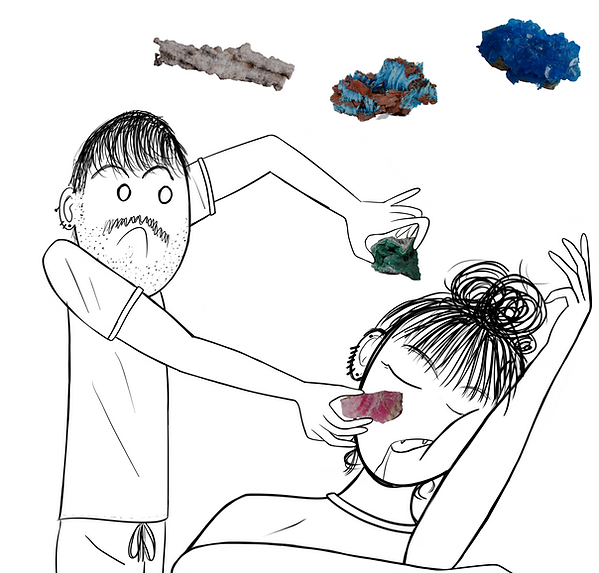
In this episode, Tyler introduces everyone to a mysterious encephalitis pandemic from over 100 years ago, discussing the disease phases, symptoms, classifications, post mortem findings, and other characteristics of the epidemic that gives clues as to the potential causes (which will be discussed in part 2, next episode). Also, Spencer introduces us to some of his favorite minerals and gemstones, including bumblebee jasper, malachite, rhodochrosite, tourmaline, chalcanthite, fulgurite, and moldavite. He includes descriptions of the minerals as well as how they form, their toxicity, and other interesting factoids.
Episode Images




Transcript:
Spencer Estes
Hello.
Tyler Brandon
Hi, and welcome to Info-Dump, a podcast hosted by two siblings who love to learn shit and then tell each other about it. I'm Tyler.
Spencer Estes
And I'm Spencer.
Tyler Brandon
I think for episodes, I wanted to try and do a conversation starter/warmup. If you're willing, I have one picked out for us.
Spencer Estes
Yeah, absolutely.
Tyler Brandon
Okay. So would you rather slowly implode or slowly explode?
Spencer Estes
That’s a really difficult one.
Tyler Brandon
Yeah, right?
Spencer Estes
I would say... maybe slowly implode would be my preference. I feel like the expansion involved with the slow explode would be more uncomfortable than painful and I would rather it be just painful so I would choose implode. And I mean that's an assumption. I have no idea what it feels like to implode or explode. But I don't know. That's a really that's a hard one because they would both be horrific! What's your answer?
Tyler Brandon
I think I also would choose slowly implode. I think… just cause I feel like I would lose consciousness faster if my brain was crushed versus if everything was slowly, like, expanding. I don't know if that logic tracks, but that's kind of my thought is like…
Spencer Estes
That's legit.
Tyler Brandon
…how quick can I be done experiencing it?
Spencer Estes
Well, also like, from a making it on the news standpoint, because that would be a story that would be told pretty widely. I feel like imploding would be way cooler, scientifically, than exploding. Yeah.
Tyler Brandon
Legacy. Yeah, assuming that you imploded somewhere people could see it versus at the bottom of the ocean.
Spencer Estes
When does the implosion stop? How small do you get compacted?
Tyler Brandon
I feel like all the space between your cells would have to disappear. But does that include atoms, too? Do we become a black hole or something at that point? I don't know that much.
Spencer Estes
Does your body turn to liquid or do you become just a super dense solid block?
Tyler Brandon
I want to say a super dense solid block, like the core of a star. Are stars solid at the center or nah? Probably not, right? It's like, is it magma, plasma?
Spencer Estes
I don't think so. It's, like, super dense, but I don't think it's solid. Now I have to Google it.
Tyler Brandon
I want to become a fifth element or a fifth state of matter. What is it? Solid, liquid, gas, plasma. Yeah, I want to be a fifth.
Spencer Estes
Google says stars are not solid in the center. They're composed entirely of plasma.
Tyler Brandon
So it was plasma. Okay. I don't want to know the circumstances that would cause any person to just implode randomly, but if it had to happen, I think I'd prefer it over exploding… slowly.
Spencer Estes
As long as it's not on a submarine.
Tyler Brandon
Yeah, gotta have an audience. Leave a legacy. A better legacy.
Spencer Estes
Yeah, I was going to say the Titan sub definitely left a legacy.
Tyler Brandon
It did, yeah. Don't know what kind, but yeah. Okay. Was that a decent warmup?
Spencer Estes
Yeah, I like that. That was a good question.
Tyler Brandon
Okay. Well, good. My next thing after a little, a little warmup, is if there was any corrections or follow-ups or comments from the last episode. And I do have a couple of corrections from when we recorded our rhinovirus and plant or natural medicines. I think they're mostly on my end. They're all on my end. Yeah. When I said it takes measles just one virus to cause illness, that is still correct, but I think what is more correct is that it can take 1 to 10. It has been proven that even 1 can cause illness, but I think more commonly 1 to 10.
Spencer Estes
Okay.
Tyler Brandon
So sure. And then instead of norovirus having just a length of illness of 1 day, like a 24-hour stomach flu, it's 1 to 3 days typically, sometimes up to a week of like malaise.
Spencer Estes
Okay.
Tyler Brandon
Not far off, but worth mentioning, I thought. I don't like being wrong in front of people. It's embarrassing.
Spencer Estes
Not wrong, but not accurate.
Tyler Brandon
Yeah, I could be… righter. And then I misspoke at one point. I corrected myself later, not even realizing that I misspoke, but we were correct in assuming that or knowing that smoking paralyzes cilia in your respiratory tract. But I accidentally called them villi at first, which is like the finger-like projections in your lower intestine.
Spencer Estes
Mmm, okay.
Tyler Brandon
So I want people to know, yes, I tracked that mis-speaking moment, but it does paralyze those. So that's what smoking does. And lastly, I had another one from mine when we were talking about, oh, this is actually from yours, but it was me that was wrong. That's what I meant. This was when we were talking about eating the liver of calves, I think.
Spencer Estes
Yeah.
Tyler Brandon
Okay, I think I said something along the lines of you shouldn't eat a shit ton of liver at once because one of the vitamins in it you can overdose on. I thought that it was vitamin K. I was kind of just guessing. It is vitamin A you can overdose on by eating too much liver.
Spencer Estes
Interesting.
Tyler Brandon
Yeah, I just wanted to get those out there.
Spencer Estes
Very good.
Tyler Brandon
Cool. That is all I have before topics.
Spencer Estes
You're going to see me keep glancing out the window because it is horrifically windy here yet again and the trees are movin'.
Tyler Brandon
I was going to ask if it was as windy at your place as it is at mine. So it must be.
Spencer Estes
Yeah, it's been knocking plants over all day. I'm surprised the trash cans are still standing.
Tyler Brandon
Nice. At least it's nice out and not zero degrees like it was last weekend.
Spencer Estes
Yeah. Yeah, I mean, I'm not like outside outside, but I'm building stuff in the garage. So like kind of outside with the doors open.
Tyler Brandon
Yeah, it was last weekend.
Okay, who wants to go first? Are we keeping the same order?
Spencer Estes
What's your preference? It doesn't really matter to me.
Tyler Brandon
Mine's probably going to be a little long. That's why I have it split into two parts. So do you want to get the long one out of the way?
Spencer Estes
That's fine.
Tyler Brandon
Okay, will do. So the topic that I'm presenting today is encephalitis lethargica, which is kind of a medical mystery. It is a pandemic from about hundred years ago. It affected multiple countries, thousands of people, and no one really knows what the cause is. There are lots of theories on what the causes are and those theories are what we're gonna have to get into during part two. Right now, during this episode, I'm gonna give like all the background so that we can like gather all of our information we do know and try to see if we can come up with some guesses of our own.
It's a lot of information and I went through my notes to try and take stuff out to make it shorter and I just couldn't. I was like, the people need to know this stuff to make a proper judgment on what they think it could be. I don't know. I took out some of the more technical jargon that I didn't think was totally necessary, but it's a decent amount of info. But it's cool. It's a mystery. Who doesn't like a mystery?
Here is a quote from the case notes of one of Dr. Kinnier Wilson's patients- I don't know if that's how you say his name, but it's K-I-N-N-I-E-R- from 1927: “Patient lies in bed looking like a pillar of salt. There is a sphinx-like immobility about her countenance. Her face is as expressionless as if it were carved out of granite”. Spooky. Like her soul is gone.
Spencer Estes
I hope she wasn't conscious behind all that.
Tyler Brandon
…
There's your foreshadowing. There's your foreshadowing. Yeah.
Skip to 82 years later. This is another case report, this time published in the Hong Kong Journal of Pediatrics in 2009. So, I'm going to go through this whole case study because it kind of gives you the overview of what this illness is.
After a week of sudden onset mutism, agitation, anxiety, and reduction in consciousness level, a 12 year old girl presented for medical intervention with whatever was going on. So this is a 12 year old girl. Her sleep pattern was disturbed, she had excessive daytime sleepiness, but insomnia at night. She didn't claim to have a history of preceding upper respiratory tract infection or drug intake. And I put a comment in here that I didn't exactly know why the respiratory illness was important, but we might see why that medical history would have been important for like the theories that come up.
When they took a look at her, they discovered a low-grade fever, masked appearance, and oromotor dyskinesia, which just means she was experiencing involuntary, repetitive, and sometimes sustained movements of the face, lips, tongue, and jaw. In addition, her left arm and leg were rigid, which is something called dystonia. She had exaggerated tendon reflexes and her eyes would occasionally roll upwards into her head. The kind of sporadic, perhaps sustained, eye movement abnormalities that are going to be seen in a lot of these are referred to as “oculogyric crises”. So “oculo-“ for eye and then “gyric-“ like a gyroscope. Is that a gyroscope? Yeah. These attacks usually lasted about an hour, they claimed.
Based on her symptoms, they obviously assumed some sort of neurological disturbance was taking place and ordered the appropriate testing. To their surprise, I'm sure, her CT came back normal as well as her CSF tests from her spinal tap. Her day three MRI was also normal. So this is after multiple days in the hospital already. Viral and bacterial cultures were negative as was the PCR testing for Enterovirus, herpes simplex virus, which is HSV, and Mycoplasma. Two of these are viruses that are common causes of meningitis and encephalitis, and then the third, that Mycoplasma, is a bacterium that's known to cause those types of infections in children.
The care team performed a myriad of blood tests for all the usual stuff and also the unusual stuff, none of which gave them any help. These included antibody tests for Japanese encephalitis virus, mumps, measles, HSV, varicella zoster virus, Mycoplasma pneumoniae, enterovirus, influenza A and B, etc. So none of the known stuff. A result of note was the oligoclonal bandings that were present in her cerebral spinal fluid but were not present in the blood. Without getting into too much detail, this is just a finding that's consistent with inflammation of the central nervous system, most commonly seen in multiple sclerosis but also some other various conditions like encephalitis, meningitis, Guillain-Barr syndrome, subacute sclerosing panencephalitis, which is one we talked about last week from measles, neurosyphilis, stroke, Lyme disease, and HIV. So lots of stuff can still cause those results. So even though they had it, it wasn't really helpful in narrowing it down. Yeah, without anything to go on, they decided the best course of action was to treat her for acute encephalitis with intravenous acyclovir, which is an antiviral.
Spencer Estes
Okay.
Tyler Brandon
To their relief, her fever subsided three days later. However, she was still experiencing increasing episodes of limb rigidity, dystonia, uprolling eyes, the same oral tics, trouble swallowing, and walking difficulties. So, her fever might be gone, but all of her neurological symptoms are still there.
They suspected a possible seizure-like activity and started some meds for that, but it only partially worked. Due to continued neurological disturbances, they performed an electroencephalogram, or EEG, which showed slow and asymmetric background activity, which was more obvious over the right hemisphere, which would affect the left side of the There was no epileptiform discharges…. epileptiform. Yeah, I said that right. That would explain the abnormal movements and postures of her limbs. So that was kind of technical jargon for saying, yeah, there's some kind of strangeness going on; Happens to be on the side that would affect the part of the body they're seeing trouble with, but it's not epilepsy.
Due to a lack of answers in terms of cause, as well as her worsening and very specific symptoms, they decided to start treating her with levodopa or carbadopa on day 18. And you brought up levodopa during your topic last week, which was used for Parkinsonism symptoms.
Spencer Estes
Mm-hmm.
Tyler Brandon
Even after only one day of treatment with this medication, she showed vast improvements and by the second week of treatment, her dystonic symptoms had completely resolved.
Spencer Estes
Interesting.
Tyler Brandon
Yeah, right? The response to this medication confirmed the care team’s suspicions that she had a very rare and very mysterious encephalitis. To quote the case study, “The presumptive diagnosis of encephalitis lethargica was made in view of her major neurological features and exclusion of common causes of acute encephalopathy”.
So even in 2009, we are still officially using this diagnosis. But like this case, it's usually after you've ruled out everything else and it has to fit certain criteria, which we'll see further into my discussion, I guess. So what we will be discussing, is an encephalitis that is/was known for causing major sleep disturbances among other neurological symptoms. And in many cases could result in a progressive Parkinsonism. And this happens like months or years later. And that is if you don't die from the acute phase, which a lot of people did. Like this was killing people. It's not just turning them into zombies. Sorry, I've got a runny nose.
Spencer Estes
So do I.
Tyler Brandon
That's right! You're recovering from your illness, yes?
Spencer Estes
Yes, I'm almost back to normal. I've just got some like productive cough still and a stuffy nose.
Tyler Brandon
Gotcha. That's annoying, but not as bad as fevers and aches. Yuck. Well, good.
Spencer Estes
Yeah, I agree.
Tyler Brandon
Okay. Even though there have been rare sporadic cases in recent times, I'll be using the past tense to describe it since the majority of the literature and cases come from the epidemic that was over 100 years ago. Here's a quote from 1928 that gives kind of an oversimplification of the disease: “Easy graduations from somnolence to sopor, sopor to stupor, and stupor to coma”. Somnolence was used a lot in all the stuff I was reading and that just means “sleepiness”. You're sleepy, tired, exhausted. “Exhausted” is probably the better word for it. So the questions that have yet to be answered is what causes it? How is it transmitted? If it is transmitted person to person and could an epidemic happen again?
So here is a timeline of events of the epidemic/pandemic. In 1915/1916, there were the earliest cases beginning in Europe. In late 1916, multiple physicians across Europe were coming across clusters of patients who had a variety of symptoms. And this included meningitis, multiple sclerosis type stuff, delirium, and encephalomyelitis. So lots of inflammation of the central nervous system. But despite the range of seemingly unrelated illnesses, illness presentations, these patients all had one symptom in common: an irresistible and unrelenting need to sleep, AKA marked lethargy. And that quote or summarization, it's a little… how do you want to say… over exaggerated? We'll come to find out that not everybody had this same extreme sleepiness, but it was a symptom that a lot of people had.
Spencer Estes
Okay.
Tyler Brandon
It was a symptom that, even though it's not in every single case, it was notable and unusual and it was used to link these cases. These combinations of neuropsychiatric symptoms coupled with this marked lethargy led many physicians to the conclusion that this was a newly described disease. Numerous descriptions started popping up in published academic papers, some just days apart. And two physicians that will be mentioned multiple times are Von Economo and Cruchet… I think it's Cruchet, C-R-U-C-H-E-T. And these are like European. I'm not European, I'm sorry.
Spencer Estes
That's how I would say it.
Tyler Brandon
We go forward 1, maybe 2 years to 1917. This is officially recognized as a disease of its own at this point. One of the physicians, Dr. Constantin von Economo, published his 1917 manuscript of the disease in 1917 and entitled it “encephalitis lethargica”. So he was the one that coined the term. Although, there were so many people writing stuff I'm sure you could claim that multiple people came up with it at the same time. But he was treating patients at the psychiatric neurological clinic of the University of Vienna. And by the end of the pandemic, which was nearly a decade after it started, over 9,000 papers got published about it.
Spencer Estes
Wow.
Tyler Brandon
That's, yeah, that's how significant this was. Everybody was trying to get their case studies in, their thoughts in, their theories. So, there's lots of literature. I obviously didn't go through it all, but I tried to go through as much as I could manage. Despite the vast number of papers that have been written on it though, it's mostly from that decade-long period of disease. There's very few case studies in modern times.
But we will continue to 1918. The first case of encephalitis lethargica in the UK was reported. This was in London in the spring. This same year, there were a couple of other historical events of note going on as well, which might be important to keep in mind when we get to the theories later. The first thing that was going on was that the first cases of Spanish influenza was reported in Kansas with a few cases quickly popping up everywhere else across the globe. This was the Spanish Influenza Epidemic beginnings. Also, World War I was still going on. So, two very important worldwide events still happening. Yeah, yeah. Not a great year, 1918.
By 1919, “the epidemic had overrun most of Europe, the USA, Canada, Central America, and India”. Cases were also reported in Japan, Australia, the Middle East, South Africa, and West Africa. So, it's everywhere now. 1920- the Spanish flu was winding down, but this mysterious encephalitis was increasing. This was one of the peak years of the epidemic, 1920. In the US, there were very few cases up until this time. So, this is when it really ramped up in the US, I guess. 1924 was another one of the peak years. And then if we skip to 1928, by this time, it was estimated that half a million cases of encephalitis lethargica had occurred. And then finally around 1926-1929, encephalitis lethargica cases started dropping off. This was the decline of the pandemic.
In summary, worldwide from 1918 to 1930, the number of cases by the end of this time was likely to exceed a million. Another variation of the pandemic dates might be 1920 to 1929, if anyone cares. That's one of those things where it's kind of like people's opinion. Does it start when the very first case starts? Does it start when it jumps countries, continents?
Spencer Estes
Right.
Tyler Brandon
But it was about a decade of disease. And then, according to a 2017 paper, there has been no epidemic recurrence of encephalitis lethargica since the early 20th century, but sporadic cases continue to occur. So, no epidemic, but still sporadic cases. Anything of question or comment with the timeline of events? Neither one of us are really history buffs, so…
Spencer Estes
No, it was very well laid out. I just, keep having little ideas pop into my mind on what I think could be potential causes. So I'm interested to hear what the theories are later.
Tyler Brandon
Yeah, and you can always pop in with whatever comments that you have. I will not personally reveal anything officially until I get into the theories, just not to have any spoilers, you know?
Spencer Estes
Yeah. Okay.
Tyler Brandon
This is a very, very small section that basically compares this epidemic to some other mysterious epidemics. Neurological epidemics were not unknown and there were comparisons made to the other conditions such as the English sweats, which was 16th century Europe. Kriebelkrankheit, if I said that right, occurred in 15th and 16th century Germany. And Raphania, which occurred in 18th century Sweden. So these were some other kinds of mysterious illnesses that they never really found the cause of. It wasn't unknown to have these epidemics, but the extent of encephalitis lethargica was unprecedented. So, these other things have happened, but this was way beyond those other ones.
In what ways was it unprecedented, you may ask? Well, the sheer quantity of cases, for one. More than a million people suffered from severe neurological disease and there were at least half a million fatalities from encephalitis lethargica.
Spencer Estes
Well, that's quite a bit.
Tyler Brandon
It's a lot for something you don't even know what the cause was, yeah. It's important to realize that these illnesses and deaths are in addition to deaths caused by the war, Spanish flu, starvation, and other ailments of the time. So, death on death. And then another important factor is that the length of this epidemic was different than the others. It was often described as an ongoing battle and that it's overstaying its welcome, lasting far longer than other possible psychogenic or infectious plagues of earlier times. There's far less cases now, but it's still ongoing. The last survivor from the decade of disease died in the UK in 2002. He didn't succumb to the acute infection. He must have got the Parkinsonism. Or they had an acute infection, survived it, and maybe never got the Parkinsonism. Not everybody gets it. But a survivor of the epidemic of encephalitis lethargica passed away in 2002. And then of course the sporadic cases that I mentioned. So, 100 years ago feels like it's pretty far removed from where we are now, but it's really not. I say that and then I'm like, shit, 2002 was over 20 years ago.
Spencer Estes
Right. It doesn't feel like it, but yeah.
Tyler Brandon
It doesn't. I know we were kids then, but still. We were alive when that guy was alive. So…
Now I'm going to get into the clinical presentation, which we kind of got a taste for with that 12-year old’s case study. These descriptions may help give insight to the pathology and thus potential origin of the disease.
Most physicians characterize the illness into acute and chronic phases with the two phases overlapping and blending into one another. It wasn't like a strict hard line on when you would move to an acute into a chronic phase. Sometimes it's way, way far apart. Other times… I don’t even know why I'm explaining this. I just kind of explained it in that sentence. Sometimes they blend together. The symptoms overlap. Okay. Explaining something that doesn't need explained.
So the acute or primary phase- This is an initial gradual onset of non-descript flu-like symptoms. Very generalized. This includes malaise or just not feeling well, perhaps a low-grade fever, pharyngitis like sore throat, shivering, headache, vertigo, vomiting. Overall, there might be a presence of encephalitis usually with a headache (as one would get) and then there might be psychiatric shifts especially in children, which in their case, would be a lot of anti-social behaviors or anti-social like personality disorder type stuff. It could be that like they're just cranky from being sick but the types of changes they were seeing in these kids was completely uncharacteristic. It was kind of bizarre and the fact that it was affecting kids more than adults lends more credence to the fact that it's probably neurological because their brains are not fully developed.
And then this non-specific presentation progresses to a more serious neurological array of symptoms, sometimes alarmingly rapidly. Here is a list of some of these symptoms: We've got disorders of ocular motility (like your eyeballs rolling around or pulling to one side or pulling up) caused by weakened or paralyzed ocular, movement disorders in general (tics, twitches and involuntary muscle movements), stupor or mental apathy. Can you say stupor? Is that just how it's supposed to be said? Stupor?
Spencer Estes
Stupor. I'm pretty sure it's just stupor.
Tyler Brandon
Okay. [Stupor] is kind of like a zoned out type look/feel. Mental apathy, which kind of leads to the next symptom of mask-like faces, which was used a lot. It just seemed like people were stone-faced. There's toneless speech to go along with those stone-like faces. It was often thick and slurred, kind of like when you're trying to talk in your sleep, if that makes sense. Obviously unconsciousness at some point. There might be respiratory anomalies. And then obviously excessive sleepiness or other alteration in the sleep cycle. This can include hypersomnolence, which is excessive sleep, pseudosomnolence, which is non-true sleep, or insomnia, the inability to sleep. So, it's like all sorts of various disturbances with the sleep-wake cycle. And there can be convulsive seizures, stroke, and virtually any other neurological sign or symptom. It seems kind of nonspecific but might target some areas more than others. Whatever inflammation is going on.
The main symptoms that were identified by a 2024 study give a percentage with them. If anyone's interested, they can try to search a 2024 study on this. But the most common symptoms that were identified were the motor features, the cranial nerve findings (which is like the nerves in the head and face that would maybe accompany paralysis or motor tics), Opsala-, Opsalamolotorj-, Opsamolotical-, Opsamolot-…
Spencer Estes
Ophthalmological.
Tyler Brandon
Thank you. I was just going to keep going until I got it. Those types of features were in 77%. And then next would be the sleep disorders. So all those other features that I just said, the motor features, cranial nerve findings, the eye features, all happened in a higher proportion than the sleep disorders. But the sleep disorders was still like 66% or more. And then some other common ones were gastrointestinal or nutritional features, speech disorders, psychiatric features, and then just to list a whole bunch of other symptoms: depression, headache, various cranial nerve disturbances, ophthalmoplegia, blurred vision, staring, increased muscle tone, tremor, masked faces, bradykinesia, focal weakness, reduced spontaneous movement, hypersalivation, underweightness, tachycardia, high temperature, monotonal speech, bradyphasia, hypersomnia, insomnia, fatigue… a lot.
I just wanted to list off all those symptoms to just how much was attributed to this disease. Not all of it is necessarily a direct cause of the disease. It might be a consequence of like, they're sleeping so much, they're not eating. And that would lead to perhaps that underweightness, tachycardia from dehydration, etc. There's just, there's a lot in here, but not all of it is directly related. It might just be a consequence of this almost comatose, but still kind of there state.
Anyway, there could be day-to-day, even hour-by-hour shifts in symptomology. To help recognize and diagnose this strange illness and its multitude of presentations, the previously mentioned guy, Von Economo, created three classifications. There's Somnolent-Ophthalmoplegic, which was the sleepy, eye-paralyzing kind. There is also a hyperkinetic kind, which would start with an initial manic phase. And then there's also an amyostatic-akinetic kind, which is characterized by muscle tremors and those interfere with your ability to stay upright, basically. They kind of seem unrelated, but they were able to separate them in this way. I'm going to give a little bit of detail about each one.
Spencer Estes
Okay.
Tyler Brandon
The sleepy eye paralyzing kind was the most common. It typically develops soon after those prodromal non-specific symptoms, like, the flu-like symptoms we talked about. Specific symptoms of this classification includes being dazed, confused, and delirious. There's features of mild meningeal irritation, and the meninges are the coverings that surround your brain. So that's up in your head. There are also cranial nerve disturbances which include the eye. Most notably though, there is an overwhelming desire to sleep, which lasts extended periods of time. And this was also very unusual sleep. These people were easily awakened and often aware of everything that had happened around them. That's that pseudo-somnolence or the non-true sleep. And then, patients could answer questions normally even while in a supposed sleep, waking as if they were never unconscious.
Spencer Estes
Weird.
Tyler Brandon
Yeah, very weird. The mortality rate for this type is higher than the other forms, which is 50%. That's a lot. To give you an idea, one of the strains of Ebola has a mortality rate of like 55%.
Spencer Estes
That was the first example I had thought of.
Tyler Brandon
And of course there's several strains of Ebola, but one of them has a 55 % and this subcategory of encephalitis lethargica has a 50%. That's crazy. But what are they actually dying from? The overwhelming somnolence could lead to immobility and vulnerability to infections and respiratory failure. So think of bedridden patients. If you're laying down for a long time, a lot of times your airway will get gunked up. But you can also get like bed sores, UTIs, et cetera. Then there can be complications of brainstem dysfunction, such as respiratory arrest, aspiration pneumonia, and secondary bacterial pneumonia. And remember, this was in the 19-teens/1920s when it started. There was no widespread use of antibiotics until the 1940s. So, these people just kind of had to deal with it. They didn't get to treat it like we do today.
And then other causes of death from this subtype included pulmonary edema (fluid accumulation in the lungs) along with acute pulmonary hemorrhage (bleeding). This could lead to deep vein thrombosis and pulmonary embolism. So nasty stuff, not all of it directly related to the central nervous system inflammation and dysfunction. But I did have it in there, brainstem dysfunction leading to stuff. Very unpleasant. It doesn't sound exactly like a fast death.
Spencer Estes
Yeah, it sounds like a slow torture.
Tyler Brandon
Yeah, especially if they're trapped. But despite the higher mortality rate, a larger proportion of survivors experienced few if any long-term sequelae versus other forms.
And then a little bit of the hyperkinetic form- Like I said, it presents with an initial manic phase. This includes chorea, which is involuntary, abrupt, jerky, and dance-like movements. Think of choreography. And then vocalizations. What are the people that have involuntary vocalizations?
Spencer Estes
Like Tourette's?
Tyler Brandon
Yeah, kind of like that, but maybe less. I don't know if they were saying words or just making noises. They didn't really specify. They just said vocalizations.
Spencer Estes
Mm-hmm. Tourette's but on the exorcism side.
Tyler Brandon
Yeah, combine the two. And then there would be myoclonic twitches, which are sudden brief twitches, myorhythmia, which is slow rhythmic jerky movements of the ocular and masticatory… masticatory…
Spencer Estes
Masturbatory.
Tyler Brandon
I knew you were gonna go there. I was like, oh god, slow rhythmic jerking, no.
Spencer Estes
I know. I was gonna say something but I was like nooo. But then you kept dragging it out so I had to.
Tyler Brandon
Cause I can't say “masticatory”, which is just your chewing muscles. Is that the people that do crack that look like they're chewing something all the time? Or is that meth or one of those?
Spencer Estes
There's a pretty wide variety of drugs that will cause that if you abuse them.
Tyler Brandon
Probably. But it kind of looked like they were constantly chewing something. Also, there's like the eye twitching, eye movement, jerkiness, whatever. They weren't chronically jerking off.
Spencer Estes
Well, they might have been, but not at this time.
Tyler Brandon
If they were, they kept it to themselves. The manic phase was followed by generalized restlessness, weakness, and fatigue that persisted for days. So, they used all their energy and then they lost all their energy. Some refer to this as the hypomanic phase. They would experience neurologic pain in the face and limbs, visual and tactile hallucinations. How shitty would that be? And then day-night sleep cycle reversal. So, it still has that sleep cycle disturbance to it. Just not necessarily the excessive sleepiness like coma type.
That was all hyperkinetic. This next one is the amyostatic-akinetic, which is that muscle tremor, can't stand up, whatever. I don't exactly remember what makes this different, but we are about to find out. This is the least common form. Symptoms include rigidity, lack of movement or minimal movement, slow to change posture, no noticeable weakness. An interesting feature of this presentation was flexibilitas cerena. Yeah, I think I said that right. AKA waxy flexibility. I'll read a quote that kind of gives you an idea of what this means. “Patients remained rigid and immobile for long periods of time, but the rigidity could be overcome with slight external force”. They wouldn't move on their own, but you can move them.
Spencer Estes
They were poseable.
Tyler Brandon
Exactly. Yeah. The affected remained mentally intact, but emotions were hardly noticeable on their masked faces. They were trapped within their own heads. And then recovery could be slow or rapid with the conditions sometimes lasting several months. And that's where that weight loss, depression, dehydration, etc. might come into play.
There are a ton of other classification systems for this illness. There's over 30 subcategories. So, it makes you kind of wonder if it really is all one disease or if some of these are misdiagnoses. Is there miscommunication of symptoms? Is there overdiagnosis? Things like that. A couple of other very specific diagnoses that you could have for this. If a patient has extensive hallucinations, you could call it psychiatric encephalitis lethargica. If they presented primarily with muscular rigidity or trouble with movement or that mask-like, there's a specific one for that. If it presents with seizure-like activity and restlessness, it's a different one. Or if it's like oculolethargic, monoclonic, choreiform, psychomotor, there's a type for it all. But the ones that we talked about are the main categorizations that are, I believe, fairly used today. And that was all the acute phase, so like the immediate illness.
The next phase is the chronic phase. This could take months or years to advance to, and that's if they didn't succumb during the acute infection phase. For the most part, they developed the chronic phase in one to five years. Outliers could progress immediately to chronic or could take over a decade to get there. The longest cited like time frame between phases was 45 years. It's like at that point you think you're all good but…
Spencer Estes
Hmm. Yeah, you think you're out of the woods and...
Tyler Brandon
Yeah, exactly. And you're like “45? How old was this person when they got sick the first time?” A lot of it was like kids and young adults. So, it makes a little more sense that you could have 45 years between the two. It's crazy, still crazy. The acute phase was most commonly characterized by Parkinsonian-like signs. In the decades following the epidemic, it was estimated that as many as 50 % of Parkinsonism cases were post-encephalic.
I also need to say this is a quote, I'm quoting something. These aren't my words. “In the decades following the epidemic, it was estimated that as many as 50 % of Parkinsonism cases were post-encephalitic”. There we go. Misdiagnosis definitely plays a role in part of this. So to kind of take that apart, people that were diagnosed with Parkinson's, half of them, it was suspected, are from this encephalitis lethargica or other encephalitis. And that was in the decades following the epidemic, like kind of directly after.
Initially, people typically presented with stiffness and bradykinesia, like slow movements that affected the upper limbs more than the lower limbs. There's also something called kinesia paradoxical where the patient is akinetic one moment; there's a lack of movement one moment and then they're perfect perfectly mobile the next. One example is that movement can easily be triggered by an external stimulus like catching a ball. So, if you tossed them a ball while they were in this statue-like state they could break out of it really easy and catch it, apparently. And then it's stated that this kinesia paradoxical is completely unique compared to idiopathic Parkinson's. Idiopathic just means that there is no perceived cause of this type of Parkinson's. Not encephalitis lethargic Parkinson's, but like, if someone has Parkinson's and they don't have an explanation for why- it's not like the genetic type or something- encephalitis lethargica could be put into that category. And this kinesia paradoxical is a characteristic that defines encephalitis lethargica versus other Parkinsonisms that don't have a defined cause.
Spencer Estes
Okay.
Tyler Brandon
In 15 to 20% of chronic encephalitis lethargica cases during the epidemic and up to 30% in the decades following, people experienced oculogyric crises. Their eyeballs were doing some crazy shit. This is an involuntary upward deviation of the eyes that last seconds to hours. That just makes me have a headache so bad. I get headaches all the time and part of it is caused by like eye strain and stuff so I cannot imagine rolling my eyes or holding my eyes up for hours.
Unfortunately, consciousness remained intact during those crises. At least it would be unfortunate for me. The patients were unable to voluntarily move their eyes except with great effort and only momentarily. The frequency of these attacks varied from patient to patient and these crises could sometimes be precipitated or triggered by emotions, which is interesting. But if you think about it, perhaps the locations in the brain where those things are handled are in similar locations. I didn't look it up. I don't know. But it's a theory based on like, no knowledge.
Spencer Estes
Yeah.
Tyler Brandon
These psychiatric manifestations of chronic encephalitis lethargica are also notable. There were changes in mood again, especially in children. This is interesting. There could be excessive puns, joviality, silliness, psychological exhaustion. Like, so far these symptoms sound like me when I'm up past my bedtime. You know what I mean? Like you're goofy, silly, ridiculous, everything's funny, stupid. But then you go on and it turns into euphoria, increased sex drive, hallucinations, psychosis, persistent anxiety.
It sounds like a mess. Psychiatric manifestations have been claimed to be more common and more pronounced in children, having included a case where an eight-year-old girl- trigger warning for people- an eight-year-old girl extracted all of her teeth and self-enucleated both of her eyes, which means she popped her eyes out.
Spencer Estes
Wow.
Tyler Brandon
Yeah, there's really something going on in these poor heads, these poor people's heads. And yes, an eight-year-old girl had chronic encephalitis lethargica because remember, some people can immediately go from acute to chronic or sometimes it only takes months or maybe a year or two. Then just some other symptoms of note: sleep disturbances, oculomotor abnormalities, involuntary movements like that chorea we mentioned, torsion spasms, monoclonus, and tics, especially affecting the jaw, lips, tongue, and palate. And then there can also be speech and respiratory abnormalities, which includes respiratory tics. And as two people with health anxiety, that would be torture to have like, particularly the respiratory tics.
Spencer Estes
Yeah, I can't even imagine.
Tyler Brandon
No, absolutely not. There can also be ghost pains decades after recovering, which I think can be attributed to nerve damage, it sounds like. They have personalities or impressions of “extinct volcanoes”. Which is so fucking sad. It, like, takes the life out of people. It doesn't kill them, you know?
Spencer Estes
Yeah
Tyler Brandon
There is an example here of one patient by the name of Francis D. They survived acute encephalitis lethargica in 1919, experienced respiratory crises, ocular seizures every fifth day for some reason. They had loss of eye control, contorted facial expressions, trouble speaking, physical movement problems. These symptoms gradually worsened. And then she was sent to a home in the 1960s called Beth Abram. She eventually developed post-encephalitic Parkinson's disease, or PEP, which traps patients within themselves. So, I can't remember if we'll talk about her later on in part two, but that's just an example of the kinds of things people had to live through. It's... It really sucks and, like, she had to be put in a home away from her family probably because they weren't able to take care of her, you know?
The relationship between acute and chronic encephalitis lethargica is disputed and remains unclear. Not everyone who got acute encephalitis lethargica got the chronic, potentially including entire epidemics. I have a question mark under that, so that's kind of unclear. And then not everyone who got presumably chronic encephalitis lethargica could recall having an acute case before.
Spencer Estes
Okay.
Tyler Brandon
There was a lot going on. Who knows? Maybe they did have something and just didn't get seen for it or it was so mild. They didn't realize they were sick. I don't know, because that happens with viral illnesses that, yeah, they could have been misdiagnosed or maybe…
Spencer Estes
Or they were misdiagnosed. I have this assumption hearing all of this that it was probably at least somewhat common that doctors were lumping misdiagnoses of other diseases into these categories.
Tyler Brandon
Yes, it definitely plays a role, especially back in a time where we didn't know each and every cause of every illness yet. Like, we still don't, but at least now we have a better idea. But yeah, misdiagnosis definitely plays a role, especially if there's a “new disease”. You probably are like, “yeah, this is that new thing that's going around”, even if it's not.
Spencer Estes
Yeah.
Tyler Brandon
I do think we talk a little more about that, but we will find out that misdiagnosis is not the cause. Like, there does seem to be something else responsible for this epidemic besides just misdiagnosis or something. I think I even mention, although it's very briefly, so I'm fine saying it now, mass hysteria. But for reasons we'll get into later, it's not mass hysteria. Maybe in some situations where people might have thought they or their loved ones had it, might've been a case of hysteria, but this was not a mass psychogenic illness, if that makes sense. Yeah. So just knowing that kind of makes it that much more interesting.
Spencer Estes
OK.
Tyler Brandon
We've talked about all the symptoms and stuff that happen while the patient’s alive. The next section is discussing what things look like after they have died. So post-mortem findings. And unfortunately, there's not a ton to go off of. But these postmortem findings will hold other clues that could help solve the mysterious cause of encephalitis lethargica, or it could not. Let's find out.
Many of the findings that I'm going to talk about are supported by a 2024 study, which of course I'll have all my sources listed. The following information is gonna be about exams of deceased acute encephalitis lethargica patients. So these are people that died of the acute phase, not the chronic. One of the findings was a hyperemic meninges. And I'm gonna give the disclaimer right now. I have probably mispronounced a lot of words so far and I'm going to continue to. I don't really care that much. As long as you can understand what I'm referring to, I just don't care. So please. Okay, but a hyperemic meninges. This just describes that meningeal layer around your brain, specifically that it has an increased amount of blood flow.
They also found that these patients had a soft edematous brain or it had edema. This can also be described as a swelling of the brain due to excess fluid. So kind of think of it as a normal brain being a precooked hot dog and the edematous brain being a boiled hot dog. Know what I mean?
Spencer Estes
Okay.
Tyler Brandon
I don't know if that helps at all. I'm sure if you took those brains out, they would probably fall apart easier. Brains are not that solid. The ones that they see in movies, well, obviously those are fake, but like, if they weren't, they'd be preserved in formalin, which has a tendency to harden tissues as well, like make them more rubbery. Brains are really soft.
Spencer Estes
Yeah.
Tyler Brandon
So yeah, kind of like a watered-down jello perhaps for an excess fluid brain.
And then also in these patients, there was a reddish discoloration of the brain stem. There were also indications of acute or sudden onset infective processes, such as evenly dispersed hemorrhagic and inflammatory lesions. I pretty much summarized that one to just be like, it looked like there was some sort of infective process going on, potentially infective, whatever it was, it was an acute disease that was causing physical damage to the brain.
There was also vascular congestion of the brain as a result of lymphocytic vasculitis and proliferation of the endothelium. This can also be described as lymphocytic infiltration. Basically, the vasculature within the brain had too many cars on the road when it came to like white blood cells and stuff. It was getting jammed up, congested. This led to thrombosis, so like clots, infarction, which I think just refers to a cutting off of an oxygen supply or blood supply, and hemorrhage. So too many cars on the road.
There's also vascular calcification and you don't want calcification because that kind of hardens your blood vessels, makes them less willing to expand and contract when you need them to for like blood pressure changes. So there is vascular calcification not as a result of atherosclerosis, which is another disease. So this calcification occurred not from atherosclerosis, but something else. There's many potential causes of calcification, less commonly including autoimmune diseases and infection.
There was also nerve cell death, neuronophagy and astrocytosis. All that to say nerve cells were dying. And then the neuronophagy and astrocytosis is trying to clean up the mess. Your white blood cells are trying to clean up. The astrocytes are cells in your central nervous system that are trying to help maintain things. These are indicators that there is something not good going on. It's not just psychogenic. It's not in their head. It is in their head, but it's not in their head.
The most affected part of the brain seemed to be the cranial nerve nuclei, followed by the upper midbrain and substantia nigra, as well as the basal ganglia, pons, medulla, and thalamus. And you may be wondering, what the fuck does that mean? I don't think it's important for us to know what all of that means. For the purpose of this episode and like people listening, I don't think you necessarily need to know what that means unless you want to look it up for yourself, if you have more questions. But the point of that is to say that it seems to have targeted areas that it affects more frequently than others. The functions of these brain parts correlated to these symptoms that were seen in patients. Makes sense. It's tracking. And that does include the sleep wake cycle stuff. So without going into the details, those parts of the brain were affected and it makes sense with the symptoms
To summarize the acute brains, there was definitely something going on with these people and it cannot all be explained by mass hysteria or psychogenic illness, like we already said. And then we have the chronic phase encephalitis lethargica brains. I know this is a lot and you might not find it helpful, but I at least would like the information to make that determination myself, you know?
Spencer Estes
Yeah.
Tyler Brandon
But these chronic phases of brains showed modest degrees of focused or generalized atrophy, which is the wasting away of brain tissue. The microscopic examination showed evidence of both old and new inflammation, suggestive of persistent infection. Makes sense if they had an acute central nervous system infection before.
Spencer Estes
Yeah, duh.
Tyler Brandon
Duh, exactly. But you know, with mysterious things like this where you don't know the cause and you don't even know if you're seeing a new disease or not, or if like it's a misdiagnosis, it's nice knowing that stuff. Like, yeah, it seems like “duh” to us now, but at the time you're like, “yes, this means something. We’re on the right track. This is a different disease”.
In people who experienced post encephalitic Parkinsonism, or that PEP, they had marked neuronal loss and gliosis throughout the brain stem. That is again saying that their neurons were dying and the gliosis is describing the helper cells of the brain that are trying to maintain and clean up and stuff. This neuronal loss and gliosis occurred particularly in the substantia nigra and to a lesser extent the locus coeruleus. And I am gonna explain a little bit about what this is. Like I said, gliosis is the reactive process in the central nervous system that responds to injury, inflammation or disease that involves proliferation and activation of glial cells, which are the support cells of the brain and spinal cord. Then the part of locus ceruleus is the brain's main source of norepinephrine. It plays a crucial role in regulating arousal and attention. And this is like sleep-wake arousal, not the other kind of arousal. So it plays a crucial role in regulating arousal and attention, the sleepwalk cycles, and the stress response. It also influences mood, learning, memory, motor control, and has a role in the brain's immune response. And if we remember back to like the symptoms of chronic encephalitis lethargica from earlier, obviously the arousal and attention and sleep-wake cycles were affected in these people.
This next part is particularly interesting to me. There was presence of neurofibrillary tangles or NFTs in encephalitis lethargica. What are these? Well, they're abnormal proteins that accumulate in neurons and cause cell dysfunction and death. These are seen in Alzheimer's.
Spencer Estes
Interesting.
Tyler Brandon
Yes, I thought so too. They were first identified in 1907 by Alois Alzheimer in the brain of a dementia patient. They are aggregates of abnormal tau protein found in primarily the brains of people with Alzheimer's disease. They are a characteristic hallmark of this disease and contribute to its progression because like we said, it causes cell dysfunction and death.
It's an accumulation of abnormal protein. Kind of makes sense. Normally, this protein is involved in supporting and stabilizing microtubules, which are structural molecules in neurons. But in Alzheimer's disease, tau protein becomes hyperphosphorylated, which just means modified with phosphate groups. And it forms twisted filamentous structures that accumulate within the neurons.
The exact mechanism behind the formation of NFTs from tau is not fully understood, but it likely involves genetic mutations, oxidative stress, and inflammatory responses. But as these NFTs accumulate, they disrupt the normal function of neurons and lead to cell death. And this process is thought to contribute to the cognitive decline and memory loss seen in Alzheimer's disease. So, NFTs are typically found in specific brain regions, including the hippocampus, entorhinal complex, and amygdala. But again, this is for Alzheimer’s.
In 1932, these structures were noted in the brain stem of a postencephalitic patient with no signs of dementia. So, what the fuck, right? Subsequently, NFTs were found in other areas of the brains of these PEP patients. The substantia nigra, locus coeruleus, pons, hypothalamus, subthalamic nucleus, red nucleus, globus, pallidus, corpus striatum, and hippocampus. So, they're kind of like all over the place in these people's brains and it's not like Alzheimer's where it seems to be found in this more specific areas.
So we know now that NFTs are found in any variety of neurodegenerative disease and we're trying to use them to distinguish between these diseases as like a topic of research interest. But for these pet people, it's not really clear what role they play or what significance they have. It's just been noted.
But that's all I had for NFTs, those neurofibrillary tangles. In this next section we’re no longer dealing with dead brains. We’re moving to epidemiology. This will include other documented information gathered during the epidemic period that gives us an idea of the types of people typically affected. So just more clues for the mystery.
There was likely under-reported during the early stages due to non-specific symptoms and not recognizing it as something new. So, it's possible that there were cases before the actual ones reported, if that makes sense. But it was also probably over diagnosed at the same time due to the non-specific symptoms and the lumping together of a variety of neurological signs and symptoms into one illness. Also, when there's an epidemic, everyone thinks that their patients have the bug or they themselves have the bug. That part could be attributed to like a mass hysteria, mass psychogenic illness type thing. It's like, “oh, I know I have it. I have this specific thing”. It's like, “actually, you have polio”. Something like that.
Postmortem examinations of alleged encephalitis lethargica cases during the epidemic period sometimes revealed an alternative diagnosis such as tubercular meningitis, which is tuberculosis that causes meningitis, cerebral tumors, meningemus, whatever that thing is, or other neurological pathology. However, due to the variability in neuropathology, even a post-mortem diagnosis of encephalitis lethargica could not be verified. So like all of those things that we just talked about in the post-mortem findings, there's no one thing that says, yes, this is encephalitis lethargica, this type of injury or these two findings together, these three findings together, they still couldn't find enough things that could say definitively, “yes, this is something distinct” versus other diagnoses. So that definitely makes it hard to diagnose. I get that. So, it could be under reported. It could be over reported. Which one did it have more of? I couldn't tell you.
And then we have something called the Matheson Report. This is the most ambitious survey of encephalitis lethargica that was conducted by the Matheson Commission for the Study of Epidemic Encephalitis in New York. This was a big ass study is what it means. This Matheson report was established in 1927 by William Matheson, a wealthy businessman who was diagnosed with encephalitis lethargica during the epidemic period. Well, good on you, William Matheson. He believed the commission could find a cure for encephalitis lethargica within two years. Sorry, big guy.
Spencer Estes
It's an aggressive target.
Tyler Brandon
It's an aggressive target, yeah, and he really put some effort into it. Here we are, 100 years later, and instead, the commission was defunded in 1940 with nothing to show for a cure. But at least they gathered some data. So that's what we're going to talk about. Their very first survey in 1929 reported 52,871 cases of encephalitis lethargica between 1919 and 1928. However, the survey only included data from 14 countries where it was a reportable disease, and even then, it only included cases that had been formally diagnosed. So, like almost 53,000 cases from just 14 countries where it was formally diagnosed. That's still a lot. That's a lot. And depending on what countries you're pulling from, you might have more or less data and it might skew from populations affected or whatnot. But that's the way it is. You just have to consider that when you're looking at the results.
It has been estimated that 50 to 75% of cases went unreported. That's a lot. I don't know how much I agree with that, but I am also not an expert, especially when it comes to mysterious illnesses.
Spencer Estes
Right, I don't feel like that's a really... That cannot be accurate.
Tyler Brandon
Right? It feels like an overestimation. Or an over-exaggeration. So, keep that in mind, but with a grain of salt. It seems as though individuals between the ages of 10 and 45 were the most susceptible, with 50% of cases occurring between the ages of 10 and 30. So, kids and young adults. Kinda like I alluded to earlier. I guess I'll go ahead and say this now because I don't know if I bring it up later. This is the age group that was most affected by the Spanish flu. Just something to keep in mind.
This is further supported by a 2024 study, the same one I mentioned earlier. Cases had a median age of 29 years. As for predilections for sex, race, or ethnicity, or rural versus urban, there seemed not to be a pattern. The only thing of note was that there were more cases in urban areas, but that's likely just due to population density.
Were there any changes or discrepancies in clinical features? As a matter of fact, there was. In 1923, there was a noted change in symptomology. There seemed to be a shift away from oculolethargic forms towards the other forms of encephalitis lethargica.
Spencer Estes
Interesting.
Tyler Brandon
Very, very interesting. I think I mentioned potential explanations in here for that. Around the same point during the pandemic, previously mentioned reports of rashes became non-existent. In the earlier cases of encephalitis lethargica, people observed a generalized rash frequently. They could be papular, macular, morbiliform or petechial. These symptoms may have been a result of the same vasculitis that was found in the brain.
And a question I have here, could it have been from a loss of virulence from some pathogenic cause? There are often mutations in causative agents of things, especially if they are a brand new epidemic strain. And this is assuming that it's of infectious origin, of course. But these mutations could help explain the changes in these symptoms. Think of it as the different strains of COVID that we saw during the pandemic. When we heard a new variant come out, sometimes there would be accompanying symptoms or they'll say, this is more contagious, but less severe, things like that. So, yeah, that could potentially explain the differences in symptoms over time.
Spencer Estes
Right.
Tyler Brandon
And then emergent pathogens will typically mutate to a less virulent form or strain in order to better exist in the normal rotation or may go extinct with or without occasional outbreaks. So that's just emergent pathogens in general, things that typically happen. There were also some weird reports of a hemorrhagic syndrome, particularly in fulminating cases of encephalitis lethargica. “Fulminating” kind of just means it got really bad really fast. So severe brain inflammation and hemorrhage that occurred in some cases was more likely to cause a distinct condition called acute hemorrhagic leukoencephalitis. It’s a rapid severe form of encephalitis that includes fever, headache, confusion, and often leads to coma, seizures, and neurological damage from brain hemorrhage. There is a correlation to a suspected post-infectious autoimmune pathogenesis and it's regarded as the most severe form of acute disseminated encephalomyelitis, which is its own distinct thing. But all that to say, there are some weird reports of hemorrhagic syndrome from this.
And then in contrast to what was said in Von Economo's reports, there were GI symptoms often found. It could be that there were poor reporting of GI symptoms, or this is like the 1920s. I bet everybody was shitting themselves all the time. So who knows whether it was correlated to this.
Spencer Estes
Yeah. Cleanliness was not at its peak.
Tyler Brandon
Definitely not. People were probably having diarrhea all the time. With that, with that comment on diarrhea, that concludes part one of Encephalitis Lethargica. That was all the background and next time I'll talk about the theories about what people think may have caused it.
Spencer Estes
That was all really interesting. I mean, it gave me a lot to think about. I'll just leave it there. I'm excited to hear part two to see if some of my suspicions are founded or not. Yeah, I like that.
Tyler Brandon
Right? Yeah. Do you have any that you want to say that so you can see if you're right next time or if it's one of the theories we'll talk about?
Spencer Estes
I don't know… my main two for like the cause would be some type of like poisoning, like a toxin exposure, or bacteria. I don't know.
Tyler Brandon
Okay, well cool, I'm excited to talk about it next time.
Spencer Estes
Yeah, me too.
Tyler Brandon
Okay, perfect.
Spencer Estes
I wonder if the lack of sleep was because of the issues with the eye. Because the circadian rhythm is, like, managed by the light coming into your eyes and stuff, like your brain is taking in the environment. So I wonder if all of the ocular problems are what had the biggest impact on people's sleep cycles during that time, or if it just was kind of, sort of frying everything related to the brain and...
Tyler Brandon
I have a suspicion that it was probably more so that it was just frying everything. All those brain parts that were affected that I kind of just glossed over because I was already talking for a long time, at least one if not more than one of those brain areas do directly control the sleep-wake cycle and all that good stuff. So I do think CNS disturbance was causing some of the sleep-wake cycle things and even though people were having those oculogyric crises, I don't think it was like… some of the attacks could last hours but like the one example that I pulled, she only had it every fifth day or something.
Spencer Estes
Right, right. Yeah, it's all very weird. Really interesting though, I literally had never even heard of it before today.
Tyler Brandon
Really interesting and that's not even the only medical mystery pandemic out there. There's so many more. This one just happens to be very widespread and lots of case reports on so I could find plenty of information about it. I'll definitely be doing more mysteries in the future but this was a big one. Yeah.
Spencer Estes
Nice.
Tyler Brandon
I'm excited to hear your topic. What do you have for me today?
Spencer Estes
Today I'm going to be talking about something a little more low key. I've been thinking about my gem and mineral collection a lot lately and wanting to go to some local expos and I'm always looking to expand it. I thought a good topic for today, something light, would just be some of my personal favorite minerals. A little bit about like, where they get their color, how they're formed. Nothing crazy, but I think that when it comes to like gems and minerals, there's gonna be 800 million different topics that you could use and... Yeah, there's just a million ways to go. So I'm going to take a little baby step into it and just, you know, highlight some of my favorites and some interesting things that I found about them.
Tyler Brandon
Yeah, I definitely want to talk about some later too. I have a category where it's like talking about how they get their various colors or, like, their light shifting abilities that produce “color”. But yes, what's your first one?
Spencer Estes
My first one is, I was about to say my first one's one of my favorites. All of these are some of my favorites when it comes to gems and minerals. I don't have a true, true favorite. If I had to pick one, it would be tourmaline, which we will get to, but it's not the first one. But I just love them all for completely different reasons. But one that's I'll say towards the top of my favorite list is bumblebee jasper.
Tyler Brandon
Yeah.
Spencer Estes
It's got an interesting composition. Let me just dive into it. So my first one's bumblebee jasper, which is not actually a jasper. You'll find out as we will revisit the topic of minerals a lot. There's a lot of things that are named one way but are not actually that thing. My biggest pet peeve being onyx and people calling things onyx that are not onyx, but I digress. So bumblebee jasper is not actually a jasper. It's a fibrous calcite. Jasper is a form of chalcedony which is a variety of quartz. So, bumblebee jasper is a calcite and real jasper is a type of quartz. Bumblebee jasper forms near volcanic vents and is formed from layers of volcanic ash and mineral rich fluids deposited under heat and pressure associated with geothermal activity. Volcanoes.
Tyler Brandon
A common feature for mineral formation is heat and pressure.
Spencer Estes
Heat and pressure, yes, absolutely. And it seems like quite a few of the like yellow and orangey ones have volcanic environments that they form in. Because bumblebee jasper was not the only one I came across that forms in similar situations. But bumblebee jasper is a very beautiful layer stone of like yellows and oranges and whites and grays and blacks and browns and it's very pretty. The yellow color comes from sulfur. The orange colors come from arsenic sulfide. And the black and gray colors come from manganese oxides.
Couple things that should have stood out in there, and you can probably assume by this point, is that this is definitely one of the toxic minerals. It is commonly used for lapidary purposes, jewelry and such. Very important for anyone who is handling raw versions of this stone- you typically get it sealed in some sort of protective layer after they've been polished. But if you're handling raw forms, if you're cutting into it or drilling or anything like that, you gotta wear a respirator. You don't wanna be inhaling that stuff. It's pretty nasty. But also interesting. Sorry, go ahead.
Tyler Brandon
Can you say that pretty much anytime you're working with a quartz type or silicate mineral because there's like silicosis as a lung condition?
Spencer Estes
Well, honestly, anytime you're cutting anything, you should wear a mask. Anytime you are cutting any mineral. I mean, depends on who you ask. It could be anything. If you're cutting wood, maybe you should wear a mask. I don't know. But specifically minerals, if you're cutting any kind of mineral, you should always wear the proper protective equipment. But if you're going to play fast and stupid, don't do it with the highly toxic ones.
Tyler Brandon
Fair. It's like microscopic glass shards.
Spencer Estes
Bumblebee jasper is on the softer side of stones. So, on the Mohs hardness scale, it's a 3 to 5. And for comparison, diamond is a 10. So it is on the softer side. It's scratched and damaged easily. Even with that, you do see it really commonly in jewelry. But again, a lot of those jewelry pieces, maybe not even a lot, probably all of those jewelry pieces have some sort of protective layer that has been applied to them. It's not going to change the hardness of the stone itself, but might prevent some like scratching from regular wear and tear on your daily, if you're wearing pendants and stuff made out of it.
Tyler Brandon
Nice, yeah.
Spencer Estes
My next one is Malachite. Malachite is a copper carbonate hydroxide mineral. It's one of the first ores used to produce copper metal. The powdered form was used as a popular pigment for thousands of years. It's a very beautiful, vibrant green. It's hard to describe the kind of green that it is. It's like a, almost like a… I would describe it as like a metallic-y...
Tyler Brandon
Yeah, kinda tealy turquoise green…
Spencer Estes
I don't think it's turquoise. I would say like a metallic-y like forest green. It's a really deep, vibrant, but not bright-colored green. It also has banding. It's not one specific shade. There are multiple different shades of the colors in malachite, but all in all, it's a darker green, I guess I'll say. But the powdered form of malachite was used as a very popular pigment for a variety of things, including paint, obviously, but makeups as well, which is scary because it's another one of our toxic ones.
Tyler Brandon
I was gonna say, you don't get green without being toxic.
Spencer Estes
Yeah, it gets the green color from copper. It forms in the oxidizing zone above copper deposits, often within limestone. This is another one of these softer ones that has a hardness of 3.6 to 4. And just like bumblebee jasper, is also really commonly used in jewelry.
Tyler Brandon
Yeah, that vibrant color.
Spencer Estes
The next one on my list is rhodochrosite. Rhodochrosite is a really cool one because it is pink. I like the pink ones. And every single one of these stones is not just one solid color. So when I describe it, you got to have some variability in your mind. Ranges from a very deep, deep, like hot pink to a very light baby pink anywhere in between. It also has many layers and bands in it of, you know, could be white or silvery and then your various shades of pinks and you know, what other minerals could be deposited as it was forming. So another one of our fun layered ones. Rhodochrosite is a manganese carbonate mineral. The manganese is frequently replaced by iron, magnesium and/or calcium. These substitutions
alter the color and hardness. Rhodochrosite forms usually in fractures or cavities of like caves and caverns and stuff and can form in many different styles. Like, it could be stalagmites or stalactites. It could have actual true crystal forms, geodes. It comes in a pretty wide variety of different forms.
Tyler Brandon
And this one can get pretty pricey depending on those forms and color. Like, I haven't bought one yet because I can't spend the money until I find one I really, really like.
Spencer Estes
I’m painfully aware. Yeah, I have a few specimens. One that's on my list that I don't have is a stalactite form. I think those ones are really cool. But I do have a slice of a very thick stalactite. And I have a couple spheres of it. I do have one that is like the actual crystal form. I like that one a lot.
Tyler Brandon
Yeah, we'll have to do a show and tell for Patreon sometime.
Spencer Estes
Yes. So it forms in fractures and cavities of metamorphic and sedimentary rocks, often associated with silver deposits. In metamorphic rocks, rhodochrosite is found as a vein and fracture filling mineral where it precipitates from ascending hydrothermal solutions. There was a lot of big words in a row.
Tyler Brandon
Mm-hmm. Silver, huh.
Spencer Estes
Repeated episodes of crystallization allow it to build up in layers on the walls of the fracture. Each layer can be a unique precipitation event and produce material with a slightly different pink color. So kind of exactly what I was saying in the beginning. Lots of layers and depending on what's in those layers will determine the colors and shades of those layers.
Tyler Brandon
Cool. So it really is like kind of like the cave-like structures. It's just forming after like layer and layer of mineral rich fluid falling down and precipitating. How cool.
Spencer Estes
Yeah, exactly. And just like the other two, also toxic. The majority of minerals are toxic. And then we get to talk about my favorite one, my true favorite, if I had to pick one, which is tourmaline, as I said earlier. Tourmaline is really cool. It is not a single mineral. Tourmaline is a group of closely related minerals. There are more than 40 recognized species of tourmaline. I don't know if species is the right word there, it is. Species was used on multiple different sites. I just didn't know that rocks had species.
Tyler Brandon
I wasn't expecting that. In chemistry, yeah, species might refer to a chemical composition grouping rather than how we know it in animals. Yeah, 40 though. I was not expecting 40 types of tourmaline.
Spencer Estes
Yeah, it was interesting. Learn something new. Elbaite, schorl, and dravite are the most well-known members of the tourmaline family. Tourmaline occurs in virtually every color of the color spectrum, and the color can be enhanced or modified by heat treatments, just like a lot of other minerals.
This one is really interesting. Tourmaline is both pyroelectric and piezoelectric. If a specimen is put under pressure or temperature change, it will generate an electric charge and attract dust particles to its ends.
Tyler Brandon
Okay, I know I'd heard that somewhere, but I couldn't remember where. That's so interesting. So how would you put this under pressure?
Spencer Estes
A pressure chamber.
Tyler Brandon
In a rice cooker?
Spencer Estes
Not a rice cooker, like a scientific, you know, because they, I don't know. I'm sure that there are synthetic varieties of tourmaline that they create in like scientific pressure and heat chambers and stuff like that. But tourmaline, unlike the last two, is one of the harder minerals with the hardness of 7 to 7.5. So it's a little bit more durable. It's also commonly found in jewelry, but on the pricier side, especially when you take into consideration the clarity of the tourmaline pieces. If it's like a really, really clear cut gemstone, that's going to be super expensive. Whereas the ones with more impurities and more roughness, the raw forms that haven't been like cut at all, are going to be cheap.
Tyler Brandon
Yeah.
Spencer Estes
But most tourmaline is pretty expensive except for black tourmaline. Black tourmaline is like dirt cheap. I have it because I wanted to have a piece of it in the collection, but honestly, it's not really one of my favorites. It's super oversaturated on the market and I just don't care for it.
Tyler Brandon
It's in everything. Yeah. I have so many other mineral specimens where I have it for the other mineral, but it happens to also have black tourmaline. That's how common it is. Yeah, it's still pretty.
Spencer Estes
Yeah, yeah, like I have black tourmaline in quartz and stuff like that, yeah.
Tyler Brandon
And then color wise, watermelon tourmaline? Pretty penny, yeah?
Spencer Estes
Yes. Yeah, the bi-color and tri-color tourmalines are, you know, is kind of towards the top end of that price spectrum. It's not just that tourmaline can come in many different colors, but also many different color combinations. You can see very commonly in the same crystal, two or three, sometimes even four different colors in the same crystal. It's really cool. Tourmaline, every single piece you see is different and unique in its own way and it's just a beautiful stone.
Tyler Brandon
I have a question. So a lot of tourmaline, at least the ones that I've seen, it forms like the same way, I don't know, a log would be split, you know? It's got like the striations… It's a long piece rather than like a crystal or, I don't know, anything else, a globular mineral…?
So if it's growing, maybe in a direction, because those color changes normally happen as a gradient up the spire or whatever, it's not a spire either. I don't know what I'm trying to say at this point.
Spencer Estes
It's a crystal, it's just not a pointed crystal.
Tyler Brandon
Yeah, not like a typical quartz crystal like people typically think of when they hear crystal. I just don't know the proper way to describe the structure. Maybe like a wood chip type of structure? Where it's like long, longitudinal.
Spencer Estes
It looks like a Jolly Rancher.
Tyler Brandon
Yeah, I feel like that's a fair description. Yeah, and the color changes typically happen as a gradient along the long...
So I guess my question is, are the color changes in these bi and tri color tourmalines, can they ever be patterned differently than that? Or is it typically a gradient from one end to another? Is it ever splotchy or central to outer?
Spencer Estes
No, you can find it in kind of any combination and sometimes it is a gradient and sometimes it's like a clear distinct, cutoff. I have pieces that show both. I also have some that are pink on the inside, but green on the outside. So it's not a layer like up and down, but a layer like from inside to outside. It is super, super variable. I'll read off a little bit more since I realized I didn't go into how it forms at all.
Tourmaline primarily forms in igneous and metamorphic rocks growing as a complex boron silicate crystal with pegmatites or in voids via hydrothermal activity. Sorry, that was a little rough. I'm reading this for the first time off the page. It crystallizes late as hot mineral rich fluids, fluids containing boron, lithium, and other elements fills cracks, allowing for a wide range of colors and complex compositions.
Tyler Brandon
Are they gonna take our tourmaline for lithium-ion batteries?
Spencer Estes
I don't think that extracting the lithium from tourmaline would be worth the squeeze.
Tyler Brandon
I would hope not.
Spencer Estes
The composition of the surrounding fluid can change during crystal growth, often leading to zoned crystals with different colors. So as it's forming with the liquid around it and the liquid changes composition, that's how you get the different colors in the crystal.
Tyler Brandon
Fun. I wonder if geologists or other kind of -ists can use mineral composition to kind of look at an area and say this or that happened sometime throughout history to kind of puzzle piece events together?
Spencer Estes
Yeah, absolutely. Tourmaline can also get color through radiation. So some pink and red tourmalines gain their color through natural radiation over time. Very interesting.
Tyler Brandon
Interesting. Cause there's like irradiated quartz too, right? To like, synthetically change color?
Spencer Estes
Yes, there's like irradiated smoky quartz. It’s radiation treated smoky quartz that makes it a much darker brown.
Tyler Brandon
Okay, okay. And then you have things like rose quartz where solar radiation like sunlight depletes their color.
Spencer Estes
Yeah, amethyst too.
Tyler Brandon
That's right. Yeah. How interesting.
Spencer Estes
My next one is one that both you and I have, and it is the, I don't know if it's pronounced chalcanthite or chalcanthite…
Tyler Brandon
I think I said Cal. Yeah.
Spencer Estes
Okay, so this one's chalcanthite. It's a sulfate mineral. Formation occurs in the oxidized zone of copper deposits and is frequently found on the timbers and walls of mine workings where it is crystallized from mine waters. It's highly water soluble to the point where even the humidity in the air has an effect on it.
Tyler Brandon
Cool.
Spencer Estes
High humidity causes the crystals to dissolve, lose their shape, their structure, their stability. And in low humidity, it can turn the blue crystals… This is a super vibrant, vibrant-like electric blue crystal. In low humidity, though, it will strip that blue out. It'll turn those blue crystals to white. And the mineral, instead of dissolving, will kind of crumble into like a powdery substance. So for people who collect it, like you and I, and we both do this, you got to keep it in an airtight sealed container. A lot of people recommend that you put a silica gel packet or something in with it to just try to keep the humidity as constant as possible.
Tyler Brandon
That's interesting.
Spencer Estes
Or you just gotta accept that it's not gonna look the way that it did when you bought it for forever.
Tyler Brandon
Yep, I got mine in a little jar.
Spencer Estes
This is also toxic, of course, if you had guessed it, but also is the softest mineral that we talk about here today with a hardness of 2.5. This one is not used commonly in jewelry. I really haven't seen it used in anything widespread other than collections. It's also very commonly lab grown because the specimens that are mined or found with it being so soft and so temperamental, the specimens don't always look the best. So if you want a nice, pretty showy piece for your collection, you're more than likely going to find a synthetic one, which is fine.
Tyler Brandon
Mine is lab grown.
Spencer Estes
So is mine, and it looks cool.
Tyler Brandon
It does, totally. And I mean, the stuff that's leeching from the walls of mines. How natural can you say that is if you're mining? Or… is it formed on the walls or is it found?
Spencer Estes
I mean, it's both. It’s completely natural. It's there regardless of if the mine is there or not. They just find it because it solidifies in the mine, but it's like already in the rock.
Tyler Brandon
Okay, okay, that's fair. I see.
Spencer Estes
I have two more, both with really interesting formation patterns, or not really patterns, but formation events, I will say. So we have fulgurite, the lightning stone. Fulgurite is formed by lightning striking and flash melting sand. Sand, wet sand, is a pretty good conductor of electricity. And lightning is over 50,000 degrees. So the combination of both of those things, the lightning hits the sand, the sand melts and then re-solidifies into a tube-like crystal. The name for fulgurite comes from the Latin word for lightning, which is fulgur And fulgurite is nearly pure silicon dioxide. It's used in various spiritual practices like manifestation and making wishes, most commonly by setting your intention and then blowing through the tube.
Tyler Brandon
Oh, they can be hollow?
Spencer Estes
Most of them are hollow.
Tyler Brandon
I was thinking it was like a stick. Interesting.
Spencer Estes
No, they're tubes.
Tyler Brandon
Okay, I could totally see the spirituality because the whole nature aspect and the chances of lightning hitting in the right place at the right time for a formation to occur.
Spencer Estes
Yeah, and they're pretty cool. They definitely range quite a bit in size. I've seen some pictures of ones that are like a foot and a half tall. The ones that I have in my own collection are like an inch long, because these ones are also kind of pricey. They're… I don't know if I would go so far to say is they're rare, but they're definitely not super commonly found. There are limited quantities.
Tyler Brandon
And I feel like it'd be hard to make a synthetic version.
Spencer Estes
As lightning creates them, I think the amount of electricity that it would take to be able to recreate that, I don't know if that's viable. It might be, I honestly didn't look it up. I'm curious. I'll look it up later. We'll find out.
Tyler Brandon
How cool.
Spencer Estes
And then my last one is moldavite. Moldavite is a tektite, and it is the only tektite in gemstone quality. So I'll first start with a tektite is a natural glassy object formed by terrestrial debris melted by high velocity. Wait, did I read that right? I might have typed this weird. Oh, okay. No, I didn't read it right, but it was my fault, not because of the words faults. So I'll start over there. A tektite is a natural glassy object formed from terrestrial debris, which was melted by high velocity meteorite impacts. That impact then solidifies. Fuck, I fucked it up again. No, I did write this weird. It's kinda hard to read. I'm not gonna read it all. A tektite is something that is formed when a meteor…
Tyler Brandon
Center yourself. It's okay. You got this. I know what you're trying to say, but it's because I already know.
Spencer Estes
It's like not even a hard sentence, I’m just having a brain fart. A tektite is something that is formed by a meteor or asteroid impact hits the earth. It's super hot, it melts some stuff, and then as debris is flying away from the impact crater, it cools and forms a tektite. So, moldavite, specifically, is a typically green tektite. A very dark, deep green, but also has a little bit of a spectrum of color where it can be a dark green, a light green into even like shades of tan or brown. The green is the more popular of the varieties.
So, moldavite is not a crystalline gemstone and it has no crystal structure. The colors vary due to the chemical composition, usually iron or manganese content, and is found in the Czech Republic. It was first discovered in 1786. It was formed by an asteroid impact 14 million years ago. This asteroid was believed to be up to a kilometer in diameter and the impact created a powerful heat and pressure that liquefied the rocks in the area and shot them off into the air. They cooled and hardened and formed this.
Tyler Brandon
So not the meteorite, but the debris from... yes. Still very interesting.
Spencer Estes
Yes, similar to fulgurite, kind of like almost any minerals at this point have some sort of like spirituality also tied to them, but I'm specifically talking about some like deep rooted, you know, that these beliefs have been around for a long time and it's not, it is also associated with like the new age metaphysical stuff, but what I'm talking about specifically is, you know, this has been going like hundreds of years, But moldavite is also pretty well recognized in spirituality and symbolism representing, specifically, transformation and spiritual growth.
Moldavite is also, for anyone who's interested in collecting it, very frequently counterfeited. Moldavite is hard to find and as they collect more and more of it, it becomes harder to find. It is in a finite amount and is not a mineral that is replenished through the natural cycles of anything that happens here localized to our earth. You have to be hit by an asteroid. And unless another similar asteroid impact happened in the same area with the same chemical compositions and all of that. I mean, keep in mind it's been 14 million years. A lot has changed since then. We probably will never get another moldavite [formation event]. We'll get other tektites, but probably not moldavite, which is why it's frequently counterfeited. It's very well sought after because like I said earlier, it's gemstone quality. It's found in jewelry. It's very pretty and flashy. And it's cool. Tektites are very interesting. So to keep up with that demand, you will find a lot of like resins and glasses that are very convincing and look just like moldavite. If you want a cheaper option because true moldavite is pretty expensive, then knowingly buy one of the, I'll say synthetic instead of counterfeit, if it's in your price range and you just want it because it's cool to look at, get one of those. That's totally fine. But if you're looking for something authentic, know that you're probably going to pay a pretty penny for it. They're really cool though.
Tyler Brandon
I have both a counterfeit and a real and they, once you have them both side by side, you're like yeah I see the difference. Yeah, one looks like a melted glass bottle and the other does not.
Spencer Estes
Some of them are really convincing though. They use like, they've got to be using molds or something because they're able to like pretty well mimic the...
Tyler Brandon
Mold-avite?
Spencer Estes
That's funny. But that was my last mineral on this list for today.
Tyler Brandon
Yeah, that was good. You had so many different kinds, like different ways that they formed/crystal structure.
Spencer Estes
Yeah, when I was building this list, I kept going back and forth. I couldn't decide if I wanted to pick based off of different formations or different compositions and as a result of that, different colors. So there's a little mix of both in there, but yeah, a lot of these do have really cool ways in which they formed.
Tyler Brandon
Yeah, I liked it. And it just goes to show how many different situations can produce these pretty gemstones or not-gemstones. And it's so cool. I think I did have one question about the moldavite, which I have no idea if you'll be able to answer. How the hell did they figure out it was from an asteroid impact 14 million years ago?
Spencer Estes
I didn't look it up as part of this, but I have read before that they were able to determine that based off of where it was. Well, I'm going to say it and it's going to sound like I'm being a jackass, but I'm dead serious. It was all found within a radius around the impact crater and nowhere else in the world.
Tyler Brandon
Yeah, and that makes perfect sense.
Spencer Estes
So it was one of those like, “well, if we only see it surrounding this crater, then, you know, it probably came from the crater”.
Tyler Brandon
So they would have had to map out where they found these various specimens and then put them on a map and…
Spencer Estes
Yeah. Well, and also they could tell from the structure of a lot of them that they were projectiles that had cooled in the air because they were elongated.
Tyler Brandon
Ooh, okay. Yeah, I don't know that. The piece that I have isn’t like that. It's more of just a blob. But yeah, like you said, they don't have a crystal structure. They don't look like other minerals. They look like melted debris. Yeah.
Spencer Estes
Yeah, it's not a glass. It might be a glass. If I were to describe it to somebody, I would say it looks very glass-like. Not in the sense that it's clear and flat and smooth, but it just... I don't know, it's hard to describe.
Tyler Brandon
Like opaque glass, yeah. I don't know. I really like those. I'm excited for... for more.
Spencer Estes
There's a whole range of others and so many things, even just with these ones that you could continue talking about. So, we'll revisit it multiple times.
Tyler Brandon
Yes. Well, thank you. My topic for next time, of course, is going to be part two of my medical mystery. What do you suspect you'll present next time?
Spencer Estes
I don't have anything specific, but it will be weather related. I will put that out there.
Tyler Brandon
Sweet. Yes, because tis the season. It is spring. So I think the only other thing for us to do then is leave things on a good note. Which, I'm sorry, I feel like all of this was a good note. But, we will... yeah.
Spencer Estes
I do too. Tell me what you're excited about.
Tyler Brandon
This week is going to be absolutely gorgeous all week long. I know I've got to work and do some schooling, but I want to get outside or I want to do stuff in some of our local shops. You know, I want to get out because I haven't been out and I need to get out. Yeah. So that's what I'm excited for is the absolutely gorgeous weather and I wanna do something with y'all.
Spencer Estes
Yeah, it's been a long time.
Tyler Brandon
Yeah. How about you?
Spencer Estes
I am really looking forward to basically the same. It is going to be beautiful this week. And I just started a new project outside- expanding a part of the garden and I am in the process of building an arbor. So I'm really excited to see how far I get on that this week. If I am able to put enough focus and time into it, then I'll be able to finish it. But if not, I don't know, not really rushing. The temperatures fluctuate a little bit too much overnight to seal it yet anyway. But I'm excited. It's gonna be cool. I have a cool design in mind, so we'll see how it turns out.
Tyler Brandon
Your landscaping is incredible so I know it's gonna turn out great. And then we'll have to buy plants soon, of course.
Spencer Estes
Thanks. Thank you.
Tyler Brandon
I've been waiting for the right time because, you know, with that that polar vortex, now I'm nervous. But we'll go plant shopping soon.
Spencer Estes
Yeah, our store got a shipment in on Thursday and they're supposed to get another shipment in sometime this week. So maybe next weekend we can go do a little browsing.
Tyler Brandon
I would love that. Well, thank you, audience, for listening to our topics this week. I guess we'll see you next time. Bye.
Spencer Estes
See you next time.
Sources:
Tyler's:
“Medical Mysteries” Podcast: Oct. 1 2019: Encephalitis Lethargica Pt. 1: The Great War and Oct. 8 2019: Encephalitis Lethargica Pt. 2: Under the Rug
https://www.ninds.nih.gov/health-information/disorders/sydenham-chorea
https://www.sciencedirect.com/topics/nursing-and-health-professions/epidemic-encephalitis
https://www.sciencedirect.com/science/article/abs/pii/S0014482707001802